

AT&T
12 months
2024
Figma, FigJam, Maze, UserTesting
designing a bill splitting system that reduces churn by giving every line owner a real at&t identity, before letting them divide the bill.

60% of wireless customers exist as users on someone else's account, invisible to at&t, missing personalization and autonomy. 34% of those users port out specifically because someone else pays the bill. customers were solving the bill-splitting problem with venmo, apple pay, and paypal, and at&t was watching retention walk out the door because the system didn't know they existed.
a two-part product strategy. user profiles to give every line holder a real at&t identity with role-based permissions. split pay to let households divide the bill by line, device, or percentage with billing responsibility configurable per role. account owners keep full control unless they choose to transfer it. members get autonomy without account sharing. the work shipped across four customer journey stages: shop and purchase, onboard and activate, use and manage, and service and support.
This work began with a strategic question, not a feature request: why are customers porting out, and what does AT&T own that competitors don't?
The data answered fast. 60% of wireless customers exist as users on someone else's account, invisible to AT&T, missing personalization and autonomy. A significant share of those users port out specifically because someone else pays the bill. Almost half of split-bill households don't even live together, forcing constant coordination through Venmo, Apple Pay, and PayPal. Customers were solving the bill-splitting problem with third-party tools, and AT&T was watching retention walk out the door because the system didn't know they existed.
The challenge was twofold: enable native bill splitting, and solve the identity gap underneath it. You can't share a bill with someone the system doesn't know.
The solution came in two parts. User Profiles gave every line holder a real AT&T identity with role-based permissions, so Account Owners, Managers, and Members each had appropriate scope. Split Pay let households divide the bill by line, device, or percentage, with billing responsibility configurable per role. Account owners kept full control unless they chose to transfer it. Members got their own AT&T UID, managed their own line, upgraded their own device, and paid only their portion, without account sharing.
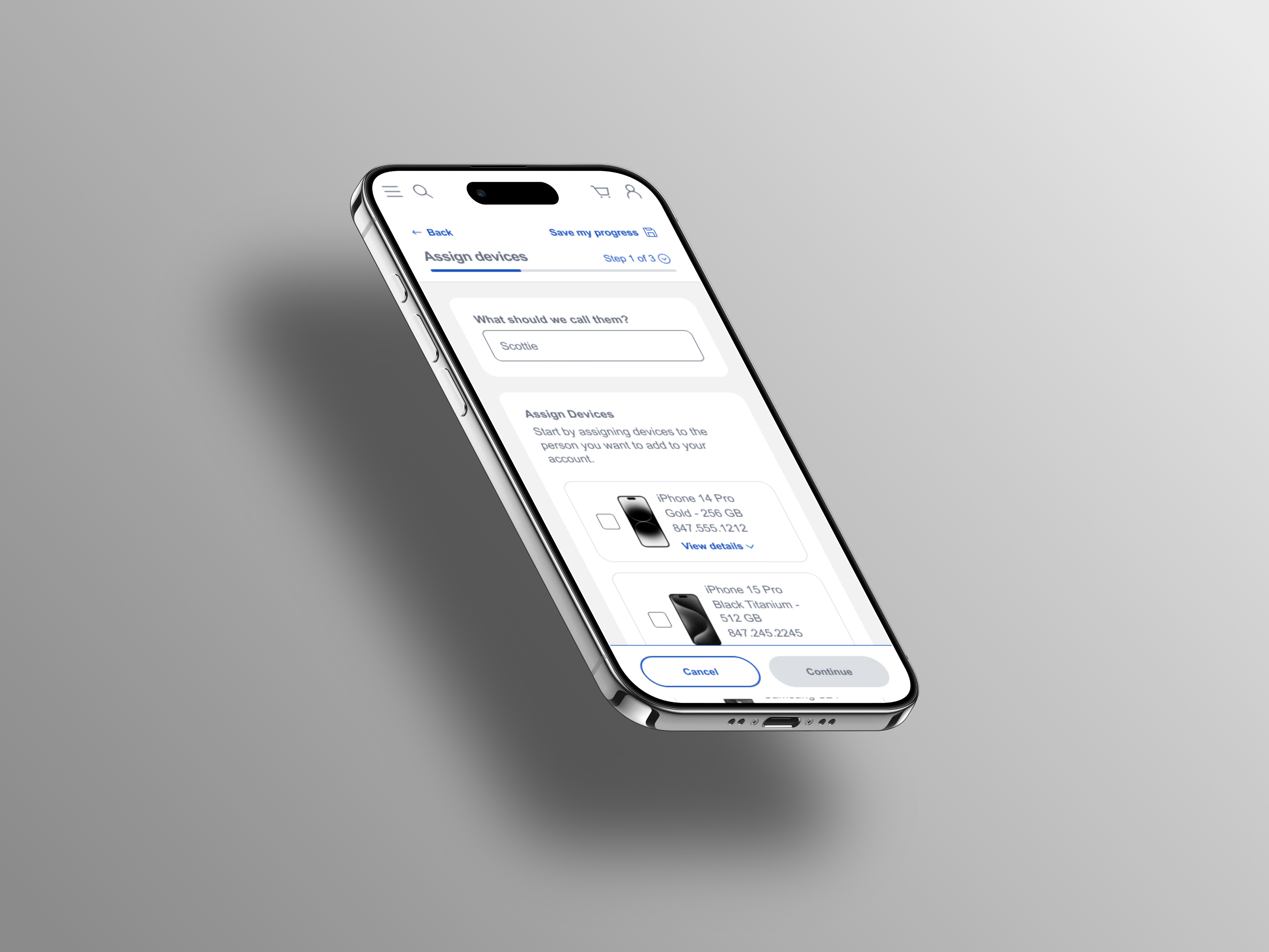
Research with account owners and line owners across multiple households shaped every decision. Moderated sessions surfaced the emotional friction underneath the financial one: anxiety about credit consequences, awkwardness about asking for money, invisibility for line holders who'd been on someone else's account for years. Competitive analysis across Venmo, Chase, Uber, T-Mobile, and Amazon mapped what each company had figured out and where the gaps were. None of them had the full picture for telecom.
The work shipped across four customer journey stages: shop and purchase, onboard and activate, use and manage, and service and support. Outcomes available on request.
Three takeaways shaped the work and travel with me into the next engagement like this:
Identity is infrastructure. Split Pay couldn't exist without User Profiles. You can't share a bill with someone the system doesn't know. What looked like scope creep was the foundation underneath the feature.
Financial friction is an emotional problem. The work that mattered most wasn't the calculator. It was designing trust into a flow where credit standing, family dynamics, and money intersect.
Competitive analysis is about finding the gap. Each competitor had pieces of the answer. The differentiation came from combining the best patterns while solving for the unique trust dynamics of a shared wireless account, and recognizing where competitor approaches actively eroded user trust.