

Modular Architecture for Enterprise Onboarding

Multi-device B2B onboarding is one of the most fragile conversion experiences in enterprise software. When small businesses bring existing devices onto a new wireless plan, the design has to hold up across multi-device setups, identity verification, plan compatibility, and approval workflows, all inside a flow originally shaped by single-device consumer assumptions.
This case study is about restructuring that experience as lead product designer. It covers how the problem was diagnosed, what changed about the underlying architecture, where AI earned its place in the flow, and what I'll carry into the next engagement like it.
This work is ongoing and bound by client NDA. Specific metrics, internal project names, and detailed walkthroughs are available on request.
The architecture is the product.
I came onto this work with the question already framed: how do we redesign bring-your-own-device onboarding for businesses without losing the simplicity that makes the consumer flow work? The answer I kept coming back to was structural, not surface-level.
The issue wasn't any single screen. It was that the architecture of the flow assumed a kind of user who didn't exist in the B2B reality. The system was built for someone with one device, one identity, one decision to make. Real customers had ten devices, multiple stakeholders, and constraints the system never asked about.
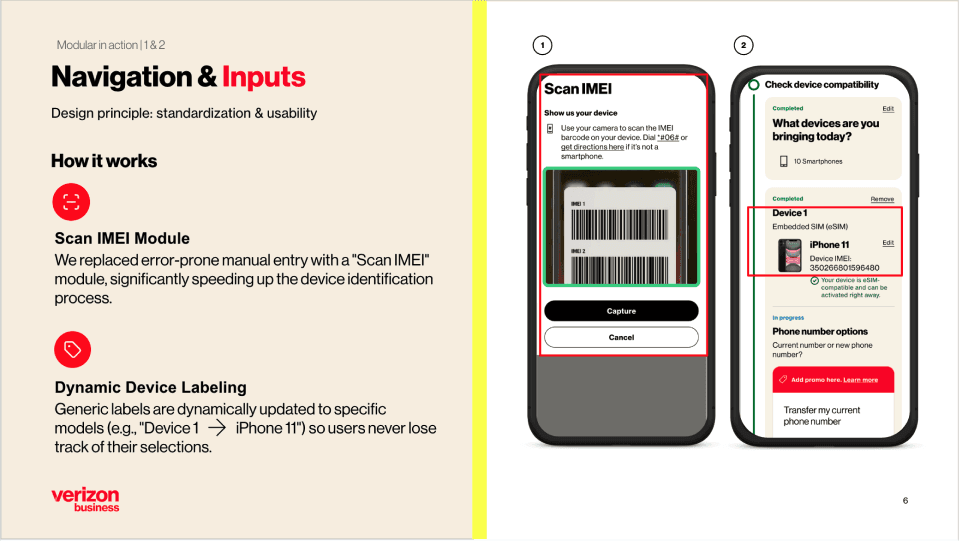
The fix had to happen one layer deeper than visual design. We restructured the experience around a modular architecture built on three principles. Standardized, meaning components follow consistent patterns for inputs, validation, and progression so users learn the system once. Self-contained, meaning each module handles one task end-to-end with no partial states crossing module boundaries. Interchangeable, meaning modules can be reordered, reused, or swapped without rewriting upstream or downstream logic.
Two research tracks ran in parallel before any pixels moved. Moderated and unmoderated usability sessions with small-business and enterprise customers identified the specific moments where the existing flow lost users. AI-powered UX analytics across three tools surfaced quantitative behavioral data, heatmaps, and exact drop-off points, validating the qualitative findings at scale. Friction wasn't where the team had assumed it was.
Where AI earns its place.
A lot of the AI work shipping into enterprise products in 2026 doesn't survive the question "why is this better than what was already there?" The version that does is the version that removes a step humans were always going to fail at.
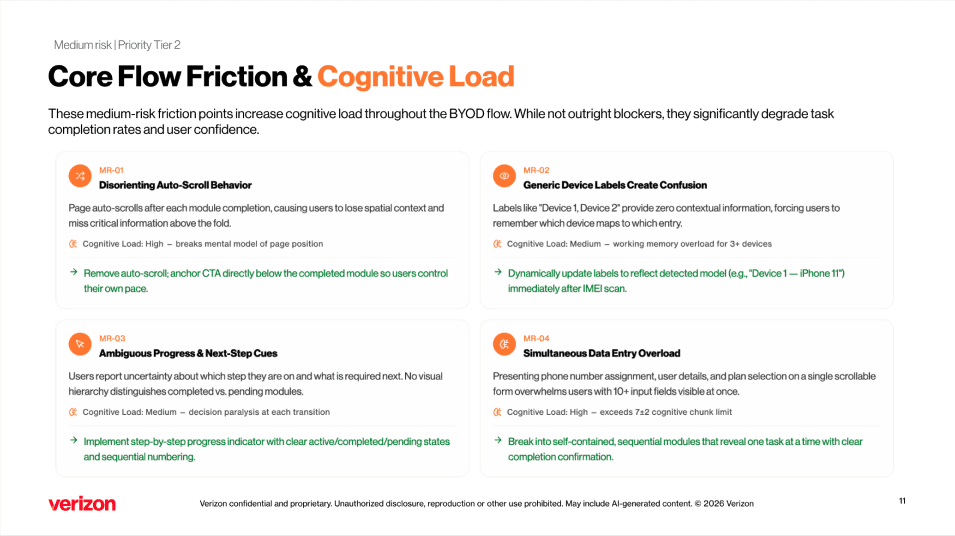
Camera-based device identification was the clearest case. Manual entry of long alphanumeric strings under pressure is a task humans are bad at and machines are good at. Replacing it with a scan flow eliminated the most error-prone moment in the funnel. Generic device labels were the second case. Placeholders like "Device 1, Device 2" forced users to remember which device mapped to which entry, especially in setups with five or ten devices. Dynamic labeling that updates to the specific recognized model removes that working-memory load entirely.
The rest of the work was about progression and clarity. Page auto-scroll was removed so users could control their own pace. CTAs were anchored directly beneath completed modules so the next required action was unmistakable. Complex steps were broken into digestible, self-contained blocks with clear progress indicators showing what was complete, what was in progress, and what was pending. Underneath all of it, the underlying design system was tightened: typography standardized to the platform's type scale, hardcoded color values replaced with semantic tokens, error and success states unified across every form module.
The takeaways I'll carry into the next engagement like this one are short. The architecture is the product. When a flow is fragile, the fix is rarely in the visual layer. AI earns its place where the alternative is broken, not where it's merely possible. And senior design is mostly negotiation. The hardest work wasn't the design. It was aligning product, engineering, and business stakeholders around a structural decision when the easier path was to ship surface changes and call it done.
date published
Jan 6, 2026
reading time
6 min